
KYC in the UK - The Specifics for Small Businesses

If you’re running a small business in the UK, you might be surprised at how quickly you can fall under KYC rules. Even if you don’t see yourself as part of the financial sector, many industries are legally required to carry out checks on their customers, and failure to do so can have serious consequences.
In the UK, KYC obligations come from the Money Laundering, Terrorist Financing and Transfer of Funds (Information on the Payer) Regulations 2017, more commonly known as MLR 2017. Oversight is divided between regulators: the Financial Conduct Authority (FCA) supervises banks, financial institutions, and investment firms; HMRC is responsible for estate and letting agents, money service businesses, and a number of other designated sectors; while professional bodies such as the Law Society or ICAEW oversee lawyers and accountants. Depending on the type of business you run, you may report to one of these different authorities.
The rules apply far beyond banks. Many small businesses find themselves within scope if they operate in accountancy, bookkeeping, legal services, real estate, high-value goods trading where cash transactions reach €10,000 or more, or certain types of online and digital services. If you’re unsure whether your activities are covered, the safest option is to confirm with your regulator or with HMRC directly.
KYC, also called Customer Due Diligence in UK legislation, is legally required in specific circumstances. This includes when you onboard a new client, establish a business relationship such as signing a service agreement, carry out certain transactions above a set threshold, suspect money laundering or terrorist financing, or doubt the accuracy of information you’ve already collected.
There are also some UK-specific features that small businesses should be aware of. Politically Exposed Persons, or PEPs, are treated as higher risk, and that applies even to domestic politicians and their close associates. Beneficial ownership is another area of focus: if you deal with corporate clients, you must identify the real individuals behind them, not just the registered entity. Businesses must also keep KYC records for at least five years after a relationship ends. And while the UK has left the EU, it still maintains strong alignment with EU anti-money laundering standards, meaning the expectations remain broadly consistent with those across Europe.
For many small business owners, KYC initially feels like an administrative burden. In reality, it’s about protecting your company, your clients, and the wider economy from serious crime. Done well, it can even build trust, signalling to customers that your business is professional and responsible. The good news is that technology now makes compliance far easier. Affordable onboarding software can quickly verify identities, run sanctions and watchlist checks, and store records securely, cutting out most of the paperwork. That means faster client onboarding, fewer mistakes, smoother audits, and more time for you to focus on running your business.
Many small business owners also have common questions about KYC. Not every business in the UK needs to do it, but those in regulated sectors do, even if they are sole traders. Ignoring the rules can result in fines, investigations, loss of licences, or even criminal charges. The UK accepts electronic verification (often called eKYC), provided the systems used are secure and reliable, and this is now a popular choice for smaller firms that can’t justify a large compliance team. Costs vary depending on how you set up your processes, but digital solutions are often cheaper than manual checks — and far cheaper than a fine.
Ultimately, KYC doesn’t have to be complicated. With the right tools, it becomes a natural part of doing business, ensuring you stay compliant while making life easier for both you and your clients. Enforcio helps small businesses achieve this balance by offering enterprise-grade compliance solutions at a price point that works for smaller firms. You can even try it out with a free trial and see how simple effective KYC can be.
Enforcio.io
All in One Advanced Platform
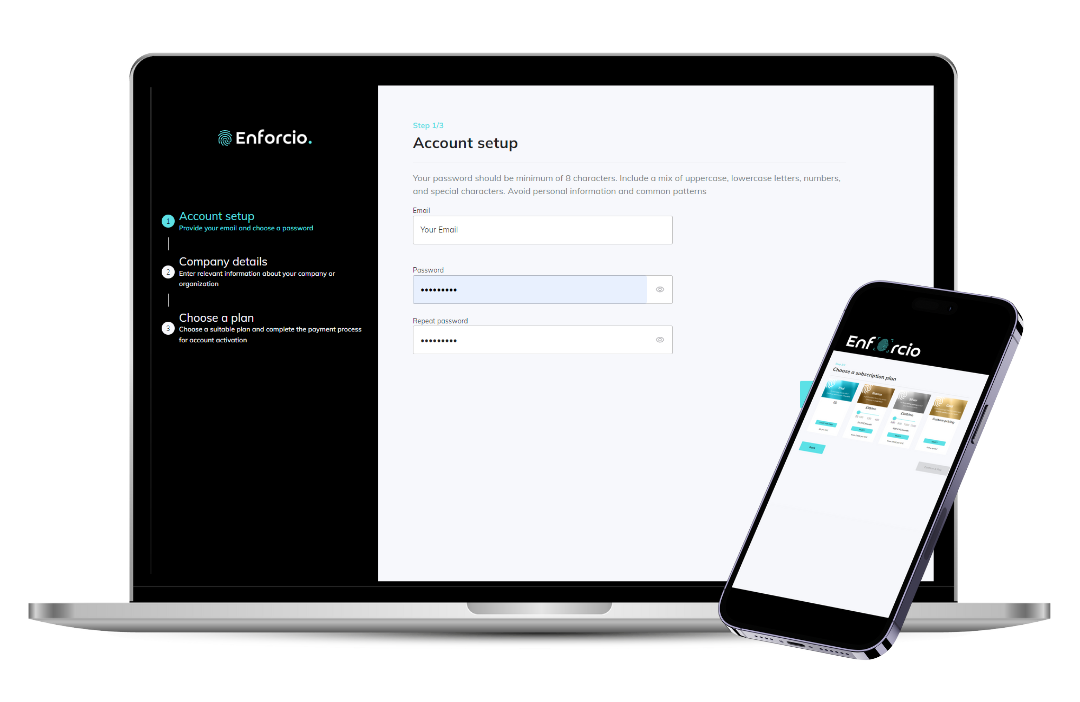
Automate your KYC & Onboarding process.
Get fast results with Enforcio, cost-efficient KYC software for ID verification, AML Compliance and Onboarding.
Onboard your clients in seconds! Client onboarding made easy with Enforcio that automates verification, evaluates risk, and simplifies compliance with evolving regulations, such as AML and KYC checks.
Fight fraud during customer onboarding.
Prevent fraud before it can cause real harm to your business, and reduce the time to verify genuine customers.
Protect your business when making new partnerships.
Uncover any risks to your firm that could arise from doing business with certain clients and prevent financial crime with Enforcio.